Reading time:
12 min
Introducing "Steering-as-a-Service"
The SaaS era is ending. As AI takes over execution, the future belongs to Steering-as-a-Service - where humans delegate outcomes and micro-steer machines, not tools.
Article written by
Shawn Curran
The SaaSacre: How “Steering-as-a-Service” Will Replace Software as a Service
For the past two decades, Software as a Service has been the dominant model for building and selling tools. We wrapped workflows in dashboards, added checklists and tickets, and called it “productivity.”
That era is ending.
We’re witnessing a SaaSacre: the slow, inevitable killing of traditional SaaS by AI-native systems. In its place, a new model is emerging:
Steering-as-a-Service.
And it will redefine how work gets done.
The Slide That Started It
When we first pitched Jylo to investors in 2024, one slide said everything.
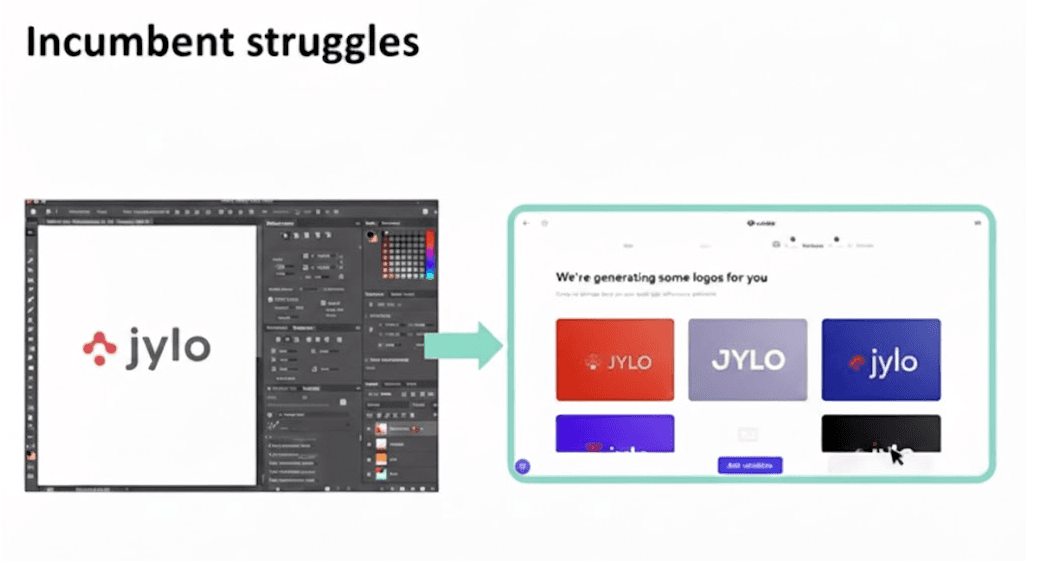
A Photoshop interface - sliders for hue, saturation, tone - but now obsolete and replaced with generative AI. Instead of editing manually, you saw ten stunning AI-generated images instantly. You picked the one you liked. Done.
No workflow.
No tool mastery.
No “learning curve.”
Just intention → output.
That slide wasn’t about design.
It was about the death of software as we knew it.
Why Traditional SaaS No Longer Makes Sense
Ask yourself:
Why is Monday.com managing human work when machines now do most of the work?
Why is Atlassian tracking tickets and documentation when code can be written faster than tickets can be filed?
These platforms were built for a world where:
Humans did the work
Software tracked it
Managers supervised it
AI flips this.
Now:
Machines do the work
Humans supervise the machines
Software must orchestrate everything
Work still needs managing.
Just not in the old way.
From Tools to Orchestration
In traditional software:
Tools did ~10% of the work
Humans did ~90%
With AI:
Machines do ~90%
Humans guide ~10%
The ratio has inverted.
That changes everything.
The most valuable interfaces of the future won’t be feature dashboards.
They’ll be orchestration layers.
Systems that let you:
Delegate at a macro level
Steer at a micro level
Intervene only when needed
This is the beginning of the new era - Steering-as-a-Service.
Macro Delegation, Micro Steering
The winners in the AI era will master two things:
1. Macro Delegation
High-level intent:
“Review these contracts for risk.”
“Build this feature.”
“Prepare a litigation strategy.”
“Analyze this dataset.”
You don’t break it into steps.
You assign outcomes or high level goals.
2. Micro Steering
Fine-grained correction:
“Focus more on regulatory risk.”
“Rewrite this section.”
“Use precedent X.”
“Tone this down.”
You don’t do the work.
You steer it.
Think: less driving, more navigation.
Why Gen-1 AI Tools Are Already Obsolete
Most first-generation AI companies made a fatal mistake:
They built AI-powered SaaS.
Not AI-native systems.
You see this especially in Legal AI and enterprise AI:
Feature soup
Disconnected tools
Procurement-friendly checklists
No coherent workflow
More features = “better product.”
Except it isn’t.
It’s just SaaS with a chatbot taped on.
These platforms optimize for buying decisions, not outcomes.
The Real Golden Goose: End-to-End Delegation
What actually matters is:
Content
Computation
Delegation
Review
Output
As one connected system.
Human + machine, blended.
Not bolted together.
Not stitched with APIs.
Not “integrated.”
Unified.
Even at Jylo, in the early days, we fell into classic SaaS traps:
Over-indexing on features
Over-building connectors
Under-thinking orchestration
We pivoted fast.
Toward a content-centric platform with:
AI-first workflows
Human-in-the-loop review
End-to-end ownership of outputs with full human auditability
That shift changed everything.
The Failure of “Almost Joined-Up” Software
Today’s enterprise AI tools tend to fall into two traps:
Trap 1: Too Technical
Endless workflow builders
Complex connectors
“Low-code” abstractions
No relationship to final outputs
Trap 2: Too Abstract
Massive tables
Hundreds of documents
“AI spreadsheets”
No operational context
In both cases:
Steering is disconnected from results.
Why Markets Are Finally Waking Up
Look at what’s happening in public markets.
Investors are seeing:
Picks and shovels alongside excavators
Horses next to cars
Typewriters next to laptops
Side by side.
And realizing:
Entire knowledge professions are about to be rebuilt.
Law.
Consulting.
Finance.
Engineering.
Research.
Strategy.
Not augmented.
Replaced and restructured.
Many Gen-1 AI startups will be SaaSacred too.
They’re just lucky most aren’t public yet - and can survive on inflated private valuations.
Reality always catches up.
Tools Are Dead. Driving Is New.
In the old world:
You learned tools.
In the new world:
You learn to drive intelligence.
You don’t master software.
You master delegation.
You don’t configure systems.
You steer them.
The competitive advantage won’t be:
Knowing Jira
Mastering Excel
Configuring CRMs
Building dashboards
It will be:
Knowing what to ask
Knowing when to intervene
Knowing how to guide
Knowing how to evaluate
That’s the new literacy.
What We’re Building Toward
At Jylo, macro delegation and micro steering are now our obsession.
Everything we design revolves around:
Intent → Execution → Review → Refinement
Continuous human-machine collaboration
Zero-friction steering
Throughout this year, we’re rolling out tools (or rather, systems) that embody this philosophy.
Not “features.”
Not “modules.”
Interfaces.
The Big Shift
Let’s be clear:
This isn’t about better SaaS.
It’s about the end of SaaS as a category.
We’re moving from:
Software as a Service → Intelligence as a Service → Steering as a Service
From:
Managing people → Managing machines → Steering outcomes
From:
Using tools → Directing systems
The companies that win will not build better dashboards.
They will build better steering wheels.
And most of today’s software companies won’t survive the transition.
That’s the SaaSacre.
And it’s already underway.
Article written by
Shawn Curran
AI that remains yours
Capture expertise and eliminate rework across your organisation.