Reading time:
8 min
Jevons Paradox, AI, and Why Seat Pricing Is Failing
Cheaper AI doesn’t mean fewer costs. For elastic work, per-seat pricing is Jevons Paradox in action - volume explodes, who pays?

Article written by
Shawn Curran

Most AI products today are priced like traditional software.
Per user. Per month. Often capped.
It feels familiar. Predictable. “Enterprise-ready.”
But as AI moves from automation into continuous analysis, this model is breaking.
Not because vendors are greedy. Not because customers misuse tools.
But because of Jevons Paradox.
When the cost of analysis falls, the volume of analysis rises.
And in many modern AI use cases, it will rise dramatically.
Jevons Paradox Meets Artificial Intelligence
Jevons Paradox describes a simple dynamic:
"When a resource becomes cheaper, people use more of it."
In computing, this has happened repeatedly:
Cheaper storage → more data
Faster networks → more traffic
Cheaper compute → more computation
AI is no different.
As model training and inference costs fall, organisations do not “save money”.
They analyse more.
They monitor more.
They evaluate more.
They run systems more often and on more data.
The result is not efficiency alone.
It is scale.
Two Types of AI Work
Not all AI workloads respond the same way to falling costs.
Broadly, they fall into two categories.
1. Static Work: Cost Falls, Volume Stays Flat
Some work has natural limits.
Examples across industries:
Financial audits
Transaction due diligence
Annual compliance reviews
One-off investigations
Pre-deal risk assessments
Take legal as an example:
IPO verification and M&A diligence happen only when a transaction happens.
If AI halves the cost, it does not double the number of IPOs.
The constraint is strategic and economic, not analytical.
In these domains:
Lower cost → higher margin
Lower cost → faster delivery
Lower cost → better quality
But not much more volume.
Jevons Paradox is weak here, which challenges the assumption Jevons applies to everything.
2. Elastic Work: Cost Falls, Volume Explodes
Other categories behave very differently.
These are ongoing, repeatable, and expandable.
Examples across industries:
Litigation discovery
Regulatory surveillance
Transaction monitoring
Fraud detection
Cybersecurity analysis
Realtime compliance
Enterprise-wide search
Take legal again:
Discovery costs strongly influence litigation strategy.
If discovery is expensive, cases settle.
If discovery becomes cheap, more cases proceed.
More cases → more documents → more discovery → more analysis.
Volume compounds.
In these domains:
Lower cost → more activity
More activity → more data
More data → more analysis
More analysis → higher total consumption
Jevons Paradox is strong.
This is where AI changes behaviour, not just productivity.
Why Seat Pricing Assumes the Wrong World
Most white-collar SaaS still prices by seat. Static work. No upside.
Every business has static parts and elastic parts.
Smart incumbents might buy seats for everyone, ditch static work, scale elastic work - huge value, but could end up crushing their supplier margins.
Smart suppliers might sell buckets of consumption to companies that will never play in elastic markets. Predictable, but capped.
Reality: buyers and sellers need to understand each other and align incentives.
At Jylo, we price hybrid. Static work = price pressure. Elastic work = growth upside. We support customers as they figure out how they want to sell services in an AI future.
Why Seat Pricing Assumes the Wrong World
Per-seat pricing assumes:
Each user generates similar load
Usage is relatively stable
Marginal costs are low
Demand is predictable
This works for traditional software.
It works for document management systems. It works for CRM. It works for contract repositories.
It does not work for elastic AI workloads.
Because AI costs scale with:
Data processed
Queries run
Monitoring frequency
Reprocessing cycles
Model inference
Not with headcount.
When Jevons applies, users do not just “use AI better”.
They use it more.
Continuously.
Across more systems.
Across more scenarios.
Per-seat pricing does not capture this.
When Vendors Become the De Facto Buyer
In elastic domains, seat pricing creates a hidden transfer of risk.
The customer pays a fixed fee.
The vendor pays variable compute.
As volume grows, the vendor absorbs the cost.
Over time:
Heavy users dominate costs
Margins erode
Contracts become unprofitable
Subsidies appear
This is already happening quietly across AI markets.
Take some new Legal AI tools doing litigation discovery.
Under per-seat pricing:
The law firm pays £X per user.
But discovery volume grows with case volume, not staff.
The vendor effectively funds the litigation workload.
They become the buyer of compute on the client’s behalf.
This is not sustainable.
Consumption Pricing Reflects Jevons Reality
Consumption pricing aligns incentives differently.
It ties cost to:
Data processed
Documents analysed
Events monitored
Queries executed
Under this model:
If volume grows, spend grows.
If volume stays flat, spend stays flat.
The party creating demand carries the cost.
This is economically coherent under Jevons conditions.
It is how cloud infrastructure works. It is how telecoms works. It is increasingly how AI must work.
Why Some Buyers Resist Consumption
Many organisations prefer seats because they appear safer.
They offer:
Budget certainty
Predictable invoices
Simpler procurement
But this stability is often artificial.
It exists only while vendors subsidise growth.
Once usage scales, repricing becomes inevitable.
At that point, customers experience “bill shock” rather than gradual adjustment.
Reframing Commercial Relationships
As AI moves into monitoring, compliance, and continuous analysis, vendor–customer relationships are changing.
The old model:
“Pay for access to software.”
The new reality:
“Pay for ongoing analytical activity.”
This requires more explicit decisions:
Which work should the customer scale?
Which should be constrained by the customer?
Who carries volume risk - supplier or customer?
Where is elasticity expected?
Mature buyers will increasingly segment their AI spend:
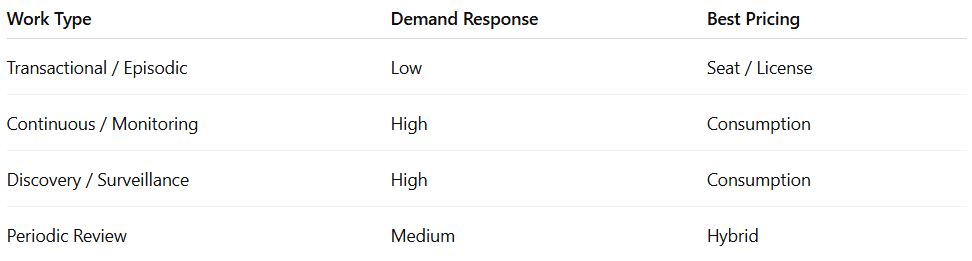
This is not about vendor preference.
It is about economic alignment.
The Strategic Implication
The next phase of AI adoption will not be driven by model quality alone.
It will be driven by pricing architecture.
As AI shifts from tools to infrastructure, Jevons Paradox becomes dominant.
Organisations that ignore this will face:
Rising hidden costs
Contract instability
Vendor churn
Budget volatility
Vendors that ignore it will face:
Margin compression
Capital dependency
Forced repricing
Customer backlash
Conclusion: Price for Behaviour, Not Access
AI is no longer just software.
It is an analytical utility.
In static domains, traditional pricing still works.
In elastic domains, it does not.
As monitoring, compliance, discovery, and surveillance become continuous and ubiquitous, volume will grow faster than headcount.
Seat pricing assumes a world where that does not happen.
Jevons Paradox guarantees that it will.
The sustainable model is simple:
Use seats where volume is naturally bounded
Use consumption where volume is elastic
Make volume risk explicit
Align incentives early
In the AI era, the central commercial question is no longer:
“How many users do you have?”
It is:
“How much analysis are you generating?”
And who is paying for it.
Article written by
Shawn Curran
AI that remains yours
Capture expertise and eliminate rework across your organisation.