Reading time:
5 min
Jylo 2.0: A Foundation for the Future of Project-Centric AI
Jylo 2.0 launches with a complete redesign, putting project-centric AI collaboration at the core for scalable knowledge work.

Article written by
Sam Lansley

Jylo has announced the launch of Jylo 2.0 - a complete redesign and re-architecture of the intelligence marketplace, built on a fresh foundation to enable a truly modern user experience. The decision to completely reimagine the Jylo platform was driven by the rapid evolution of AI workspaces, and recognition that the earliest version, while groundbreaking, introduced technical limits that could have hampered future scalability and functionality.
Getting the architecture right from the start
The original Jylo saw strong adoption, but as both user numbers and collaboration demands surged, it became clear that the underlying architecture needed to place project-centricity, not solely user experience, at the heart of the platform. While other solutions in the market built fast, low-barrier entry points - introducing users immediately to AI assistants and quick analysis tools - Jylo’s team recognized a critical gap for our core market: real-world enterprises need robust project and team workflows, not just shiny demos.
“We didn’t want to lock ourselves - and our users - into a user-centric system where project architecture was an after-thought. Early product-market fit often comes from the intelligence models, not the interface. Many competitors confuse the two - building around user-centric demos that simply don’t flex to enterprise needs. Early success can quickly become a fatal flaw when real-world collaboration and project workflows are required. Retrofitting true collaboration later would have been costly and complex, especially as we scaled into large enterprises,” says Sam Lansley, Co-founder and CTO.
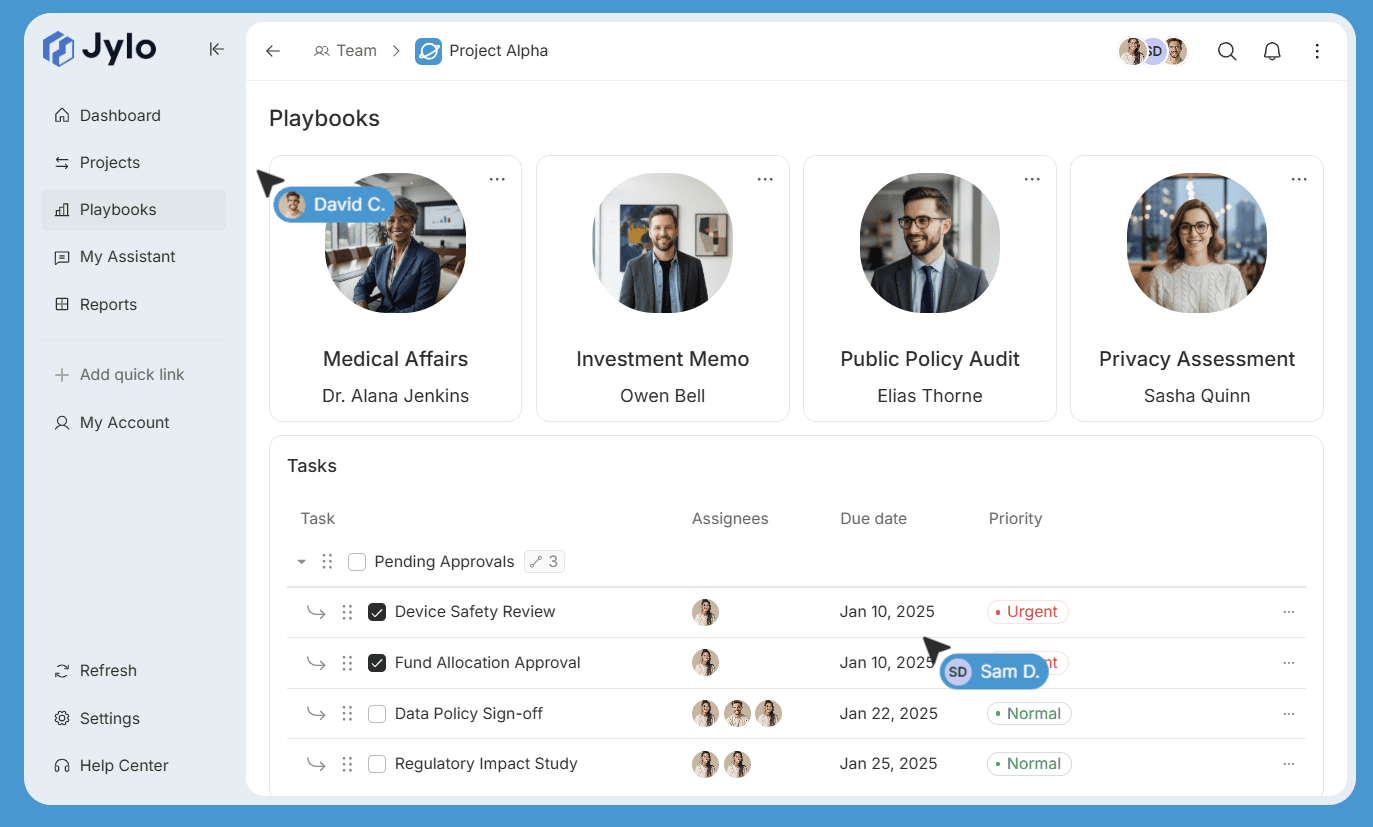
By rebuilding from the ground up, Jylo 2.0 introduces a project-centric paradigm, focusing on organized collaboration and secure, transparent team workflows. The new architecture provides a reliable foundation for advanced feature development, so knowledge is structured, actionable, and always accessible within the context organizations actually work.
Why project-centric AI matters
As AI tools shift from novelty to essential workplace infrastructure, the market is learning that meaningful impact relies on context: tying insights, decisions, and automation directly to projects and teams. Many early co-pilot tools - built for speed and low friction- failed in the enterprise because they could not reliably organize or secure business critical data as it crisscrossed individual user accounts.
“AI systems that focus on users over projects quickly reveal limitations in governance, compliance, and knowledge management at scale. Jylo’s project-centric approach solves the long-term challenges of data integrity and operational risk many organizations now face,” says Tony McKenna, Director of Knowledge & Information at Howard Kennedy.
Laying scalable foundations for the cognitive economy
While some may have seen Jylo’s additional complexity as an early disadvantage, enterprises - the organizations Jylo was built to serve - increasingly understand the value of strong foundations. The new architecture ensures that as AI becomes embedded and mission critical, Jylo delivers not just performance at scale, but collaboration, security, and organizational clarity.
“From an information governance perspective, project-centricity is essential. It’s the only way AI can truly deliver on compliance and value for enterprises,” adds Tony McKenna of Howard Kennedy.
Jylo 2.0 is now available, inviting organizations to experience the next chapter in scalable, intelligent project collaboration.
Article written by
Sam Lansley
AI that remains yours
Capture expertise and eliminate rework across your organisation.